A 13-week cash flow forecast (glossary, opens in a new tab) lists the cash you expect to come into and go out of your business every week for the next three months. It starts from today's bank balance and shows a closing balance for each week. That lets you spot a tight week while there is still time to act.
Thirteen weeks is one quarter. It reaches far enough to catch a quarterly tax payment, an annual insurance bill or a slow season, and it is short enough that your estimates stay grounded. Your profit and loss statement tells you whether you made money last month. This forecast tells you whether you can pay everyone next month.
What a 13-week cash flow forecast shows
Each week gets one column and four rows: opening cash, cash in, cash out and closing cash. The closing cash of one week becomes the opening cash of the next. Add a fifth row for your cushion, the lowest balance you are comfortable holding. Any week that closes below the cushion is a warning.
Record money in the week it actually lands in or leaves your bank account. Invoice dates and bill dates do not matter here. A $10,000 invoice on 30-day terms belongs in the week your customer really pays. Some customers pay two weeks after the terms say.
How to build the forecast, step by step
1. Start with the cash you have today
Log in to every business bank account and add up the balances. That total is your week 1 opening cash. Leave out unused room on a line of credit. Write it down separately, because borrowed room is a fallback, and counting it as cash hides the problem the forecast is meant to show.
2. Choose your cushion
Pick a floor that would cover one payroll and one month of rent if sales stopped for a few weeks. You can change it later. The point is to have a line you notice before you reach zero.
3. List the cash coming in
Begin with what customers already owe you. Go through your receivables and place each open invoice in the week you expect payment, based on how that customer has paid in the past. Then add new sales you expect, kept on the cautious side. Finish with anything else that brings cash in, such as retainers, tax refunds or a loan you have already been approved for.
4. List the cash going out
Enter the fixed, dated payments first: payroll on each pay date, rent, loan payments, insurance and software subscriptions. Then add supplier payments based on their terms. Next come sales tax and payroll remittances (glossary, opens in a new tab) (see the Canada and US section below), your own pay or draws, and one-off costs like equipment, repairs or annual renewals. Scroll through the last 12 months of bank statements to find the bills that only show up once or twice a year.
5. Roll the balance forward
For each week, closing cash equals opening cash plus cash in minus cash out. Copy that closing figure into the next week's opening cash and carry it across all 13 columns.
6. Find the low week and decide what to do
Look for the lowest closing balance and the first week that falls below your cushion. You usually have four kinds of moves:
- Collect sooner. Ask for deposits on new jobs, follow up on late invoices, or offer a card or e-transfer option that pays faster.
- Move the timing. Ask a supplier for longer terms, or ask whether an annual bill can be split into monthly payments.
- Delay or cut spending. Push a purchase that can wait past the low week.
- Arrange credit early. Lenders are easier to talk to when the forecast shows a dip months ahead than when payroll is due on Friday.
7. Update it every Monday
Replace last week's estimates with what really happened and note the biggest gaps. Then delete the finished week and add a new week 13 at the end, so you always see three months ahead. Once the sheet is set up, the update is much quicker than the first build.
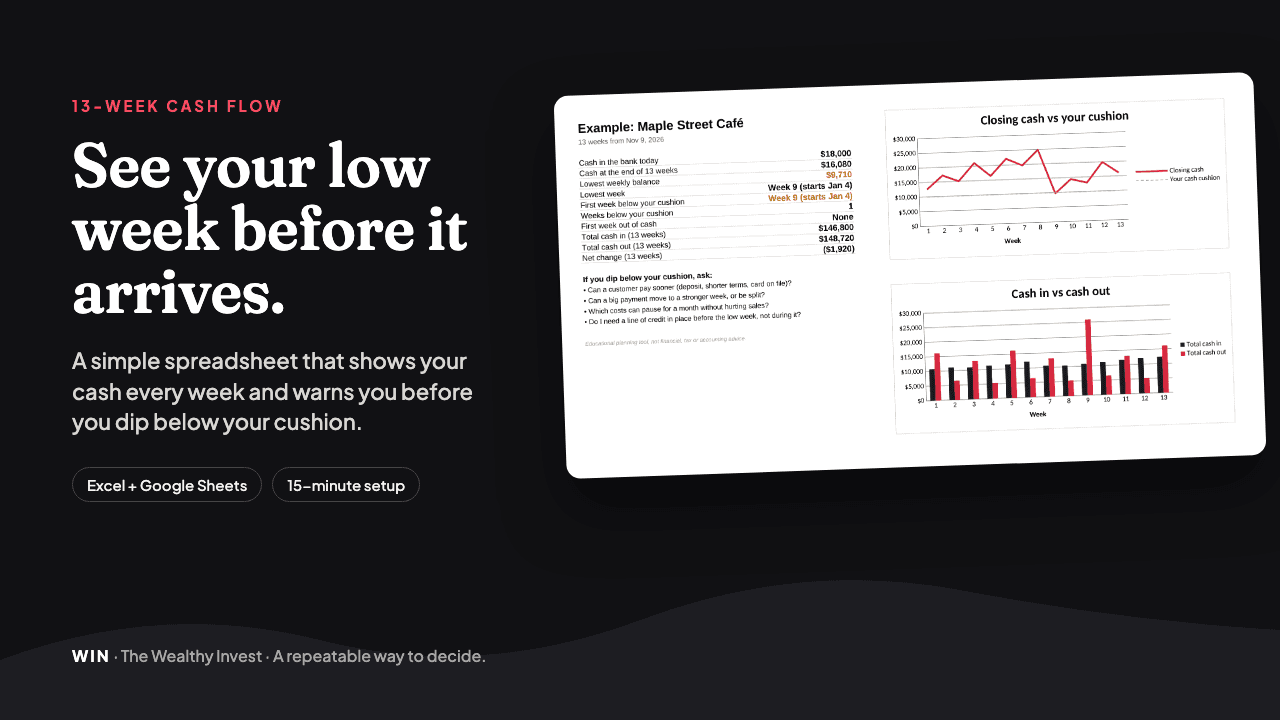 Tool · $29 USD13-Week Cash Flow DashboardSee your low week before it arrives. See what's inside →
A worked example: a small print shop
Here is the first half of a forecast for an invented print shop with three staff. It has $18,000 in the bank on Monday of week 1 and a cushion of $8,000. Payroll, including the owner's pay, is $6,400 every second week. Suppliers take about $2,500 a week and software, phones and other costs another $600. Rent of $3,200 is due in weeks 1 and 5, and a $900 loan payment in weeks 3 and 7.
| Week | Opening | Cash in | Cash out | Closing |
|---|---|---|---|---|
| 1 | 18,000 | 7,500 | 6,300 | 19,200 |
| 2 | 19,200 | 6,800 | 9,500 | 16,500 |
| 3 | 16,500 | 7,200 | 4,000 | 19,700 |
| 4 | 19,700 | 5,900 | 9,500 | 16,100 |
| 5 | 16,100 | 6,100 | 6,300 | 15,900 |
| 6 | 15,900 | 9,800 | 9,500 | 16,200 |
| 7 | 16,200 | 6,400 | 8,800 | 13,800 |
| 8 | 13,800 | 6,600 | 14,500 | 5,900 |
Week 7 includes a $4,800 quarterly sales tax payment. Week 8 has a payroll plus a $5,000 annual insurance premium, and closing cash drops to $5,900. That is $2,100 below the cushion. The shop is profitable on paper and would still be short that week.
Because the owner sees this in week 1, there are seven weeks to fix it. Say the insurer agrees to monthly billing, so week 8 carries one payment of about $417 instead of $5,000. Week 8 cash out falls to $9,917 and closing cash lands at about $10,480, above the cushion. Insurers can charge a fee for monthly billing, so the owner adds that to the forecast too. A second option would be asking two regular customers for deposits on large orders due in weeks 7 and 8.
Canada and US tax dates that move your cash
Taxes are a common cause of surprise low weeks, because the money arrives with your sales and leaves weeks or months later. Sales tax you collect belongs to the government, so show both sides: the cash in with each sale and the remittance on its due date.
Canada
- The CRA assigns your GST/HST reporting period from your annual taxable sales: annual at $1.5 million or less, quarterly above that up to $6 million, and monthly above $6 million. You can choose to file more often.
- Monthly and quarterly filers pay one month after the period ends. Annual filers may also owe quarterly instalments.
- Payroll source deductions follow a remitting frequency the CRA sets from your average monthly withholding two years ago. Many small employers remit monthly or quarterly.
- BC, Saskatchewan, Manitoba and Quebec charge their own sales tax on top of GST, with separate filings and due dates.
United States
- Sales tax is set by each state, and some local governments add their own. Each state sets your filing frequency, and a few states have no general sales tax.
- Federal employment taxes are deposited on a monthly or semi-weekly schedule. The IRS sets yours before each year based on what you reported in a lookback period.
- Owners of pass-through businesses often pay estimated tax four times a year. Put each payment in the week it is due.
- If you sell into several states, list each state's due date as its own row so nothing is missed.
Five mistakes that make a forecast wrong
- Using invoice dates. Cash arrives when customers pay, and late payers stay late.
- Forgetting the irregular bills. Annual renewals, quarterly taxes and equipment repairs cause most of the unexpected low weeks.
- Hopeful sales numbers. Forecast new sales a little below your recent average. A good surprise is easier to handle than a bad one.
- Mixing personal and business money. Keep the forecast to business accounts and show your own pay as one clear line.
- Never checking against reality. The Monday comparison is how your estimates get better. Skip it and the sheet slowly drifts away from your bank balance.
Build it yourself or start from a template
Any spreadsheet works: 13 columns, the rows above and one formula per week. If you would rather start with the structure in place, the 13-Week Cash Flow Dashboard includes a filled-in example and a 15-minute setup guide. It marks each week as OK, below cushion or out of cash.
A steady cash forecast is part of the first stage on the Wealth Roadmap, where the goal is a floor you cannot fall through. If you want help reviewing the forecast each week, our guide on how small-business owners should use AI includes a prompt for it. Buying a business? Ask the seller for their recent bank statements and build a forecast from them, as described in our due-diligence checklist.
Common questions
What is a 13-week cash flow forecast?
It is a week-by-week list of the cash you expect to come in and go out of your business over the next 13 weeks, starting from today's bank balance. Each week shows a closing balance, so you can see a low week before it arrives.
Why 13 weeks instead of 12 months?
Thirteen weeks is one quarter. It catches quarterly taxes and annual bills, and weekly detail shows dips that a monthly view averages away. Estimates beyond three months get less reliable, so many owners pair a 13-week forecast with a rougher annual budget.
How often should I update a 13-week cash flow forecast?
Once a week, on the same day. Replace last week's estimates with actual figures, note the biggest differences, and add a new week at the end so you always look 13 weeks ahead.
What is the difference between a cash flow forecast and a budget?
A budget plans income and spending for a period, usually by month, often on an accrual basis. A cash flow forecast tracks the timing of money in and out of the bank. A business can be on budget and still run short of cash in a particular week.
Should sales tax be included in a cash flow forecast?
Yes. Include the tax you collect as part of cash in, and the remittance as cash out in the week it is due. In Canada that means GST/HST and any provincial sales tax. In the US it means each state's sales tax.