Due diligence (glossary, opens in a new tab) is the period after a seller accepts your offer in principle when you check that the business is what the seller said it is. You test the numbers, read the contracts, search for debts and liens (glossary, opens in a new tab), and meet the people who keep it running.
This checklist groups the work into seven areas. It applies to small businesses in Canada and the US, with country notes where the records differ. Use it alongside your lawyer and accountant, who will run the formal searches and review the documents.
How to use this checklist
Work through it in three passes. Before you sign a letter of intent (glossary, opens in a new tab), do a light pass on the financials and the lease to make sure the deal is worth pursuing. During due diligence, do the full list. Just before closing, repeat the key checks, because things change in the weeks between.
For each item, mark one of three states: seen proof, seller said or missing. Anything still marked "seller said" near the end belongs in the purchase agreement (glossary, opens in a new tab) as a written promise, or in your list of reasons to adjust the price.
1. Financial statements and earnings
- Three years of financial statements and the current year to date
- Monthly revenue for at least 24 months, to see seasonality and trend
- Bank statements for the same period, matched against reported sales
- A list of every add-back (glossary, opens in a new tab) used to calculate owner's earnings, with receipts
- Accounts receivable by age, and how many are more than 60 days late
- Accounts payable and any money owed to the owner or family
- Inventory list and a count close to closing
- Gross margin (glossary, opens in a new tab) by product or service line, if the books allow it
Turn the last few months of bank statements into a 13-week cash flow forecast. It shows whether the business can carry a loan payment in its slowest weeks.
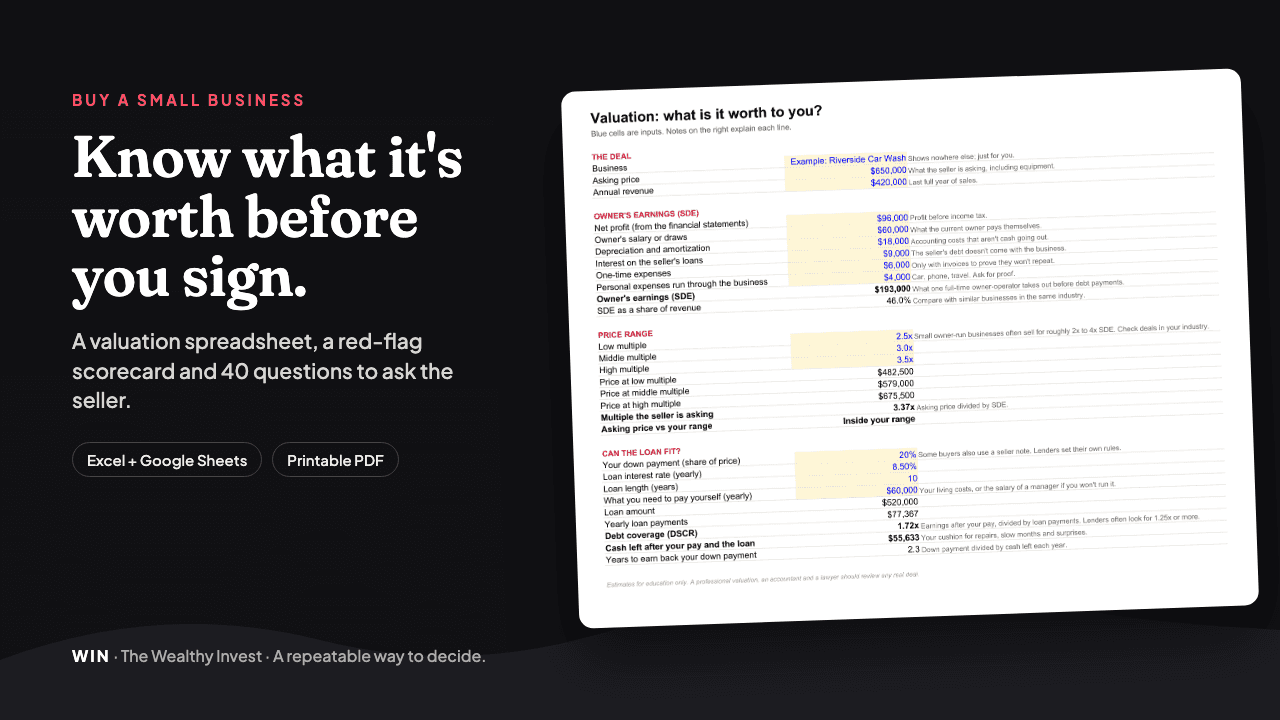 Tool · $49 USDBuy a Small Business: Due-Diligence KitKnow what it's worth before you sign. See what's inside →
2. Tax records
Tax filings are a useful check on the financial statements, because owners rarely have a reason to overstate income on a tax return. Ask for the following, and ask your accountant to compare them with the statements.
Canada
- Corporate tax returns and notices of assessment for three years
- GST/HST (glossary, opens in a new tab) returns, plus provincial sales tax or QST where it applies
- Payroll remittance (glossary, opens in a new tab) records and T4 summaries
- Any CRA correspondence, audits or payment arrangements
- In an asset purchase (glossary, opens in a new tab), whether you and the seller can file Form GST44
United States
- Federal business tax returns for three years, and state returns
- Sales and use tax filings for each state where the business collects
- Payroll tax filings, such as quarterly Forms 941, and W-2 summaries
- Any IRS or state notices, audits or payment plans
- In an asset purchase, the price allocation that both sides will report on Form 8594
3. Legal records, contracts and liens
- Corporate records: articles, share register, minutes, and who has authority to sign
- Customer and supplier contracts, especially change-of-control or assignment clauses
- Business licences and permits, and whether they transfer to a new owner
- Past, current or threatened lawsuits and complaints
- Trademarks, domain names, website, phone numbers and social accounts, and who owns them
- Equipment leases and financing agreements
Ask your lawyer to search for registered claims against the business's assets. In Canada, each province keeps a personal property security (glossary, opens in a new tab) registry. In Ontario it is the PPSR, searched through ServiceOntario. In the US, lenders file UCC financing statements (glossary, opens in a new tab) with the secretary of state where the business is organized. Either search can show a lender that would have a claim on the equipment you are paying for.
4. The lease and the location
- The full lease, every amendment, and the years left including renewal options
- Whether the landlord must consent to an assignment, and on what terms
- Rent increases, extra charges for taxes and maintenance, and any personal guarantee (glossary, opens in a new tab)
- Zoning and permitted use for the way the business operates
- Condition of the premises and who pays for repairs
Speak to the landlord before you waive conditions. A landlord who will not assign the lease, or who plans to redevelop, can end the deal.
5. Staff and the owner's role
- A staff list with roles, pay, start dates and employment agreements
- Benefits, vacation owed, bonuses promised and any open complaints
- Contractors, and whether they are truly contractors under local rules
- Which tasks only the owner does today, and how long the owner will stay to train you
- The two or three people the business could not run without
Employment law decides what happens to staff service and obligations when a business is sold, and it differs by province and state. Ask your lawyer how it applies to your deal.
6. Customers, suppliers and the market
- Revenue by customer for the top ten, and the share from the largest one
- How long the main customers have stayed, and who has left recently
- Online reviews and complaints over the last two years
- Main suppliers, their terms, and whether there are alternatives
- Local competitors, and anything changing in the area or industry
7. Operations, systems and equipment
- An equipment list with age, condition and recent repairs
- The software the business runs on, and whether accounts and data transfer
- Written procedures, or a plan to write them during the handover
- Insurance policies and claims history
- Health, safety and environmental inspections where the industry needs them
Who does what: you, your lawyer and your accountant
You can save fees by doing the gathering and the first read yourself. Request the documents, build the list of questions, visit the business at busy and quiet times, and talk to staff and customers once the seller agrees. Keep every document in one shared folder named by area, so your advisers can find things fast.
Your accountant compares the financial statements with the tax returns and bank records, tests the add-backs, and advises on how to structure the deal and split the price across assets. Your lawyer runs the lien and corporate searches, reads the lease and contracts, and drafts or reviews the purchase agreement. If the business depends on licences, environmental permits or a franchise agreement, ask early whether you need a specialist as well.
Agree on fees and scope with each adviser before you start. A short written list of what each person is checking stops important items from falling between the cracks.
Red flags that mean slow down
- Sales in the bank statements do not match the financial statements or tax returns.
- Large add-backs come without receipts.
- One customer brings in a large share of revenue.
- Taxes or payroll remittances are behind.
- The lease is short, or the landlord is slow to answer.
- The seller resists giving documents, or the story changes between meetings.
- Revenue is dropping and the explanation keeps moving.
A red flag does not always end a deal. It may mean a lower price, a larger holdback (glossary, opens in a new tab), a longer handover or a vendor take-back (glossary, opens in a new tab) that ties part of the price to results.
Before closing: the final checks
- Updated financial statements to the most recent month
- Final inventory count and working capital (glossary, opens in a new tab) figure
- Lien searches repeated close to closing
- Landlord, lender and key customer consents in writing
- A transition plan with dates for introductions and training
For the full process, from search to closing, read how to buy a small business in Canada. To check your own finances before taking on a loan, start with the Wealth Roadmap. The Due-Diligence Kit has this checklist ready to print and fill in.
Common questions
How long should due diligence take when buying a small business?
For a small business under $1M, due diligence usually takes about 30 to 90 days. A mid-size business often needs 60 to 90 days or more, because of a quality of earnings review and more contracts to read. Set the period in the letter of intent and ask for an extension in writing if the seller is slow to provide records.
What documents should I ask a seller for?
Start with three years of financial statements and tax returns, two years of bank statements and monthly sales, the lease, major contracts, a staff list, an equipment list and the add-backs behind the owner's earnings figure.
What is a lien search and why does it matter?
It is a search of public registries for claims that lenders have registered against a business's assets. In Canada these are provincial personal property security registries, and in the US they are UCC filings. A lien can give a lender rights over equipment you are paying for.
What is a quality of earnings review?
It is an independent review by an accountant that tests whether the seller's earnings figure holds up. It looks at add-backs, one-time items and cash. Lenders sometimes require one for larger purchases.
Can I do due diligence without a lawyer or accountant?
You can do a lot of the gathering and questioning yourself, and doing so saves professional fees. A lawyer should still run the searches and review the agreement, and an accountant should review the financial and tax records.