Buying a small business in Canada usually takes eight steps: set your criteria, find businesses, sign a confidentiality agreement (glossary, opens in a new tab) and review the basics, estimate what it is worth, make a non-binding offer, run due diligence (glossary, opens in a new tab) while you line up financing, sign the purchase agreement (glossary, opens in a new tab), and close with a transition plan. Most of the risk sits in valuation (glossary, opens in a new tab) and due diligence.
Buying an existing business gives you customers, staff and revenue from the first day. You also inherit its habits and problems. This guide walks through each step in plain terms, explains how purchases are usually financed in Canada, and lists the mistakes that cost first-time buyers the most. It is general education. A business lawyer and an accountant should review any real deal.
Before you start: decide what you are looking for
Write down your criteria before you look at a single listing. Without them, every business looks interesting, and you will spend months on deals that never fit.
- Industries you understand, or can learn quickly
- A price range based on the cash you can put in and what a lender might add
- Where it is, and whether you are willing to move
- How involved you want to be day to day
- The skills you bring, such as sales, operations or managing people
The process, step by step
1. Find businesses for sale
Listings come from business brokers and for-sale websites. Many good businesses are never listed. Accountants, lawyers and industry suppliers often know owners who are planning to retire, and a polite letter straight to an owner can start a conversation.
2. Sign a confidentiality agreement and take a first look
Sellers usually share a short summary first, then detailed numbers once you sign a non-disclosure agreement. Ask for three years of financial statements and tax returns, a list of what is included in the sale, and the reason the owner is selling.
3. Estimate what it is worth
Small businesses are often priced as a multiple of (glossary, opens in a new tab) seller's discretionary earnings (glossary, opens in a new tab) (SDE). SDE is the profit, plus the owner's own pay, plus one-time or personal costs run through the business, plus interest and depreciation. The multiple depends on size, risk, industry and how much the business relies on the owner. Then test whether the price works with a loan: after loan payments and a fair wage for you, is there cash left over?
4. Make a non-binding offer
A letter of intent (glossary, opens in a new tab) (LOI) sets out the price, whether you are buying assets or shares, what is included (equipment, inventory, cash needed to run the business), how you will pay, the length of due diligence, and how long the seller will stay to help. Most of it is non-binding, but confidentiality and exclusivity clauses usually bind both sides.
5. Run due diligence
Now you check everything the seller told you: the financial records, tax filings, contracts, the lease, liens (glossary, opens in a new tab), staff and customers. Our due-diligence checklist lists what to ask for, area by area.
6. Line up financing
Lenders will want your personal financial details, a business plan and the seller's records. Start this in parallel with due diligence, since approvals take time. The options are covered in the next section.
7. Sign the purchase agreement
Your lawyer drafts or reviews the final agreement. Key parts include the seller's promises about the business (representations and warranties (glossary, opens in a new tab)), what the seller pays back if those promises are wrong (indemnities (glossary, opens in a new tab)), any part of the price held back to cover claims, a non-compete (glossary, opens in a new tab), and the transition period.
8. Close and take over
On closing day (glossary, opens in a new tab), money and ownership change hands. Plan the first three months before then: how the seller will introduce you to customers and staff, which systems you will keep, and a weekly 13-week cash flow forecast so you know your cash position from week one.
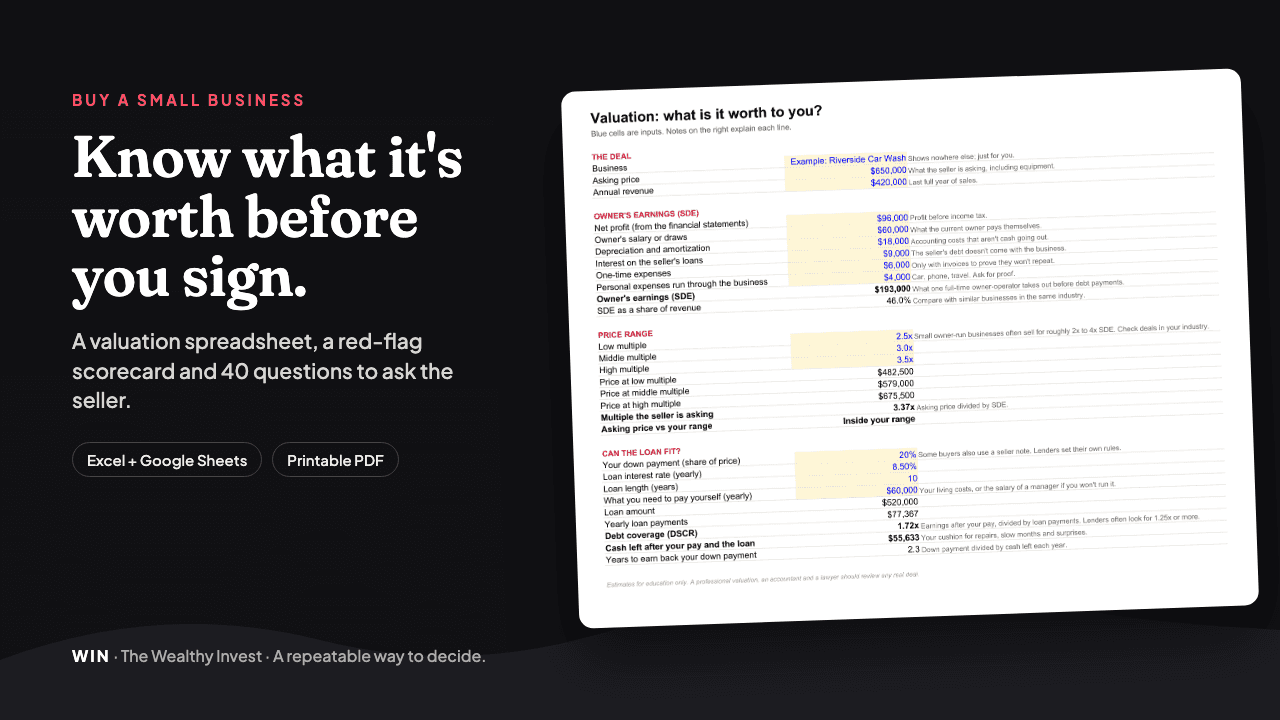 Tool · $49 USDBuy a Small Business: Due-Diligence KitKnow what it's worth before you sign. See what's inside →
How long it takes, by size of deal
The clock has two parts: the search, and the time from an accepted letter of intent (LOI) to closing day. The search is the part people underestimate. Once an LOI is signed, the size of the deal and the way it is financed decide most of the rest.
| Deal size | Search to close | LOI to closing | What sets the pace |
|---|---|---|---|
| Small business (under $1M) | About 6 to 12 months | About 2 to 4 months (cash deals can close in 1 to 2) | How clean the seller's books are, and loan approval |
| Mid-size ($1M to $100M) | About 6 to 12 months for the full sale process | About 2 to 4 months | Quality of earnings review, lawyers on both sides, key staff agreements |
| Large (over $100M) | Often 6 to 18 months | Months, plus any competition review | Competition review, shareholder approvals, financing |
Very large deals can run longer when regulators take a close look. In the US, the handful of deals that got an in-depth antitrust review in 2025 took about a year on average from announcement to a decision. In Canada, most merger reviews finish within weeks. Even a contested megadeal is usually settled in one to three years, so a deal that drags on for a decade is not a normal outcome at any size.
Staying organized at each size
- Under $1M. Keep one shared folder with a checklist, a single list of open questions for the seller and a calendar with the LOI deadlines. Bring the lender in during the second week of due diligence, not at the end.
- $1M to $100M. Use a virtual data room (glossary, opens in a new tab), a request tracker with an owner and due date for every item, and a weekly call with your lawyer, accountant and lender. Expect a quality of earnings (glossary, opens in a new tab) report.
- Over $100M. Deal teams on both sides, a project manager, a closing checklist with every approval and filing, and competition lawyers from the start. Map out the regulatory timeline before signing.
How small-business purchases are financed in Canada
Most purchases combine several sources. Lenders want to see some of your own money in the deal, and they look closely at whether the business's cash flow (glossary, opens in a new tab) can carry the payments.
- Your own cash. This shows commitment and lowers the loan. Keep some back for the first months after closing.
- Bank or credit union term loans. Usually secured by the business assets, often with a personal guarantee (glossary, opens in a new tab) from you.
- BDC (glossary, opens in a new tab) business purchase loans. The Business Development Bank of Canada offers loans to buy an existing business. BDC says the business must be Canadian and generating revenue, and that a deal may combine your investment, a loan and seller financing (glossary, opens in a new tab).
- The Canada Small Business Financing Program. The federal government shares risk with lenders on loans for things like equipment, leasehold improvements, property and some working capital (glossary, opens in a new tab). Limits and eligible uses are set by regulation and change from time to time, so ask a participating lender what applies to your purchase.
- Vendor take-back (seller financing). The seller lends you part of the price, repaid over several years. It keeps the seller invested in a smooth handover.
- Earn-out (glossary, opens in a new tab). Part of the price is paid later if the business hits agreed targets. Write the targets and the way they are measured precisely, because vague earn-outs lead to disputes.
- Partners or investors. Their money comes with a share of ownership and a say in decisions, so put a shareholders' agreement in place.
Pitfalls that cost first-time buyers the most
- Paying for add-backs (glossary, opens in a new tab) you cannot prove. If the seller says a cost was personal, ask for the receipts. Only count what you can verify.
- Customers who are loyal to the owner. If the top clients deal only with the seller, plan a longer handover or tie part of the price to keeping them.
- A lease that ends soon or cannot be assigned. For a business that depends on its location, the lease can matter as much as the price.
- Key staff who leave. Meet the people who hold the know-how, and plan how you will keep them.
- No working capital on day one. Agree on how much inventory and cash to run the business are included, or you may need to fund it the week you take over.
- Buying shares without protection. Hidden tax bills or lawsuits come with the company. Use indemnities and a holdback (glossary, opens in a new tab).
- Putting every dollar into the down payment. Keep a reserve. The first months after a change of owner are often bumpy.
- Falling for the deal. Set walk-away rules before you start and keep them.
Your next steps
Before you meet a seller, prepare your questions and a way to test their numbers. The Due-Diligence Kit includes a valuation spreadsheet, a loan check, 40 seller questions and a red-flag scorecard. Work through the due-diligence checklist once you have an accepted offer.
A purchase is also a personal money decision. The Wealth Roadmap helps you check that your own base is solid before you take on a loan. If you plan to run the business with lean help, see how small-business owners should use AI for routines you can set up in the first month.
Common questions
How long does it take to buy a small business in Canada?
For a business under $1M, plan on about 6 to 12 months from starting your search to closing day. After the seller accepts your letter of intent, due diligence, financing and the purchase agreement usually take about 2 to 4 months, and a cash deal can close in 1 to 2. Mid-size deals ($1M to $100M) often run 6 to 12 months in total. Large deals over $100M can take longer if a competition review is needed.
Is it better to buy the assets or the shares of a business?
Asset purchases usually leave past liabilities with the seller and let the buyer depreciate the purchase price allocated to equipment. Share purchases are often better for the seller's taxes and keep contracts in place. The right choice depends on the deal, so ask your lawyer and accountant.
Can I buy a small business in Canada with little money down?
Some deals combine a small cash investment with a bank or BDC loan and seller financing. Lenders still expect you to put in some of your own money and to show the business can carry the payments. A deal with almost nothing down leaves no room for a bad month.
What is seller's discretionary earnings (SDE)?
SDE is the profit a single owner-operator could take from the business. It adds the owner's pay, one-time or personal expenses, interest and depreciation back to the reported profit. Small businesses are often priced as a multiple of SDE.
Do I need a lawyer and an accountant to buy a business?
Yes, for any real purchase. A lawyer drafts or reviews the letter of intent and the purchase agreement and runs the searches. An accountant reviews the financial records and helps structure the deal for tax.